It's fairly late on our last day in New Orleans, with bags packed ready for an early morning departure. As I think about our time here and the work we did, a few things spring to mind, although I am still sorting through most of this experience (and will continue to do so for some time).
Primarily, I am again reminded of the strength of character of our students and community. The CA students were amazing from the get-go, as were the adults who were on this trip. Nobody wanted to be the one to stop working first, to not help out, to leave some task for someone else.
If you've been a regular reader of this blog, you know that most vans spent their time in the Lower 9th Ward. However, my van (Van 2) spent our first three days in New Orleans painting the inside of the Sims' house here in the Broadmoor neighborhood. When we arrived on Monday morning, we did not know quite what to expect, and many of the students had never held a paint brush, except for those in Jonathan Smith's classes. Soon enough, "cut work", "eggshell white," and the merits of rollers versus brushes were all part of their working vocabulary. At the end of the first day, we had started in on the entry way, living room, one bedroom, and the bathroom. Clyde, a neighbor of the Sims's, approached us on Monday and filled us on in on the details of the storm - water up to the first floor, beloved friends drowning in their kitchens, the loss of community.
When we returned to the mission, tired yet pleased, we began to hear about the job down in the 9th Ward. It was apparent that students felt like they were missing out. Still, on Tuesday morning we all headed back to the Sims' house and began working on the kitchen and back bedrooms. Given a choice to finish all of the interior of the house or to hand the job off to another group, the students in Van 2 voted to see the job through. I could not have been more proud of them. Only on Wednesday, once we finished the entire job, did I realize the magnitude of that decision. The inside of the house looked wonderful when we cleaned up on Wednesday afternoon, leaving the Sims' with a clean, livable space, and our students with a sense of a job well done.
On Thursday, Van 2 joined the other groups in the Lower 9th Ward. And this is the point where I'm not quite certain of what it all means. New Orleans is complicated at best, as is service work THREE YEARS AFTER A CATASTROPHIC EVENT! I find myself wrestling with the meaning of our work here: Is it the value of the work done that matters most? Or does the symbolic value of such a large group matter more? How does seeing the people who are changed by one's work impact the worker? And should that matter? I'm not really sure about any of this quite yet. It was great to hear a number of others - students and adults - struggling with the same issues this week.
I'm not quite sure what "my New Orleans story" will be to those back home...there's too much about the experience to work through. Still, I leave New Orleans grateful for all I have, and more conscious of the need to build service into my "regular" life.
Friday, June 13, 2008

Preservation Hall
Hello!
I know others are going to (or have already) posted about our final meeting as a group that happened earlier this evening. As they often do, CA students impressed me with their thoughtfulness and kindness. This has been a great week, and I'm proud to be associated with this collection of students and adults.
On Wednesday I'd been talking with several students and adults about a thorny issue -- namely, "What if the best thing would be to rebuild elsewhere?" Forty-five minutes of transformative music that night provided the clearest answer I could ever hope to have.
Preservation Hall is a remarkably small venue, a building more than 200 years old that has had many lives as a tavern, art gallery and for the last forty years the home of New Orleans jazz. The scale and intimacy of the place are unlike anything I've experienced, although it is perhaps closest to the Iron Horse in Northampton, MA. Parkman Howe found out that ten dollars buys a chance to squeeze inside with whoever else has lined up outside. Given that it was the only activity offered, many students came without any sense of what they were getting themselves into. 39 of us saw and heard a wonderful set.
Words fail me to describe what followed -- while no one of the six musicians floored me with his individual virtuosity, their ability to weave in and out of each other's solos was perhaps the best I've ever heard. From blaring stomp to a quiet lament sung by the guitar player, each song was fantastic. In the midst of the music, a small white cat jumped through the gate that led to an inner courtyard and joined me and Mike Wirtz on a bench. Soon we realized it was worth standing to see the band -- we could see now that the crowd had shifted. The cat, happy to have gotten some scratches, went back into the courtyard.
Standing watching several generations of musicians entertain several generations of audience, the answer to our question became clear. Whatever rational arguments we might have mustered in favor of relocation paled in comparison to this original American art. New Orleans jazz arose from a mix of cultures, from boom and bust, from a strong sense of place. Several students said they were glad that the Hall was unchanged, that it hadn't been replaced by a shiny new club with state of the art amenities and a plaque that said something about the original. Transplanting Preservation Hall, or Broadmoor, or the Ninth Ward would diminish that sense of place. I could feel the potential loss throughout that set -- even three years later the stakes are high here.
Thanks for reading,
John Drew
I know others are going to (or have already) posted about our final meeting as a group that happened earlier this evening. As they often do, CA students impressed me with their thoughtfulness and kindness. This has been a great week, and I'm proud to be associated with this collection of students and adults.
On Wednesday I'd been talking with several students and adults about a thorny issue -- namely, "What if the best thing would be to rebuild elsewhere?" Forty-five minutes of transformative music that night provided the clearest answer I could ever hope to have.
Preservation Hall is a remarkably small venue, a building more than 200 years old that has had many lives as a tavern, art gallery and for the last forty years the home of New Orleans jazz. The scale and intimacy of the place are unlike anything I've experienced, although it is perhaps closest to the Iron Horse in Northampton, MA. Parkman Howe found out that ten dollars buys a chance to squeeze inside with whoever else has lined up outside. Given that it was the only activity offered, many students came without any sense of what they were getting themselves into. 39 of us saw and heard a wonderful set.
Words fail me to describe what followed -- while no one of the six musicians floored me with his individual virtuosity, their ability to weave in and out of each other's solos was perhaps the best I've ever heard. From blaring stomp to a quiet lament sung by the guitar player, each song was fantastic. In the midst of the music, a small white cat jumped through the gate that led to an inner courtyard and joined me and Mike Wirtz on a bench. Soon we realized it was worth standing to see the band -- we could see now that the crowd had shifted. The cat, happy to have gotten some scratches, went back into the courtyard.
Standing watching several generations of musicians entertain several generations of audience, the answer to our question became clear. Whatever rational arguments we might have mustered in favor of relocation paled in comparison to this original American art. New Orleans jazz arose from a mix of cultures, from boom and bust, from a strong sense of place. Several students said they were glad that the Hall was unchanged, that it hadn't been replaced by a shiny new club with state of the art amenities and a plaque that said something about the original. Transplanting Preservation Hall, or Broadmoor, or the Ninth Ward would diminish that sense of place. I could feel the potential loss throughout that set -- even three years later the stakes are high here.
Thanks for reading,
John Drew
see you tomorrow!
Reflection Day! And there were many. This evening we all gathered to share our thoughts on the week's experiences, but more on that in a bit.
To catch up on what has been going on, or what has continued to go on: the group working in the Lower Ninth Ward cleared clear to the end of Forestall St. today, which means that we've cleared a total of ten blocks and helped in between 75 and 100 families!
This afternoon we came back feeling accomplished and bit pooped. After the big packing to-do we gathered in the sanctuary to share some of our mixed feelings from the week. Several recent graduates noted how they had not particularly been looking forward to spending a week of summer with their "old school," in the words of Joe Shapiro, and then felt a certain amount of pride for the community which they were leaving. Kiln veterans couldn't help but compare the experiences of this trip to last years adventures, often missing the personal connections that our work in Kiln offered but marveling at the shear amount of work that we accomplished this time around. Going back to Mississippi reminded us that progress was being made and people do seem to come back eventually. Seeing newly-built houses there and hearing about houses soon to be built in the Lower Ninth Ward reminded us that eventually the community would come back even when our work sometimes seemed to be about managing damage rather than about bringing life back to a neighborhood. There were thanks all around- to the group for working together so well, to David for leading us so well, to John and Marco for daily frozen treats. A big take-away was that the work was not only important for what the work was but for the gesture of caring and remembrance of New Orleans. A few people even hoped that after this trip they will not look so far, necessarily, for a service experience but will try to reach out into their own communities.
Finally we need to send a big thank you to David Rost for being our amazing leader. We all missed him in our last few days here (but maybe not his musical morning wake-up).
And now (drumroll please...) some pictures from the week.
Here are some from Forstall Street in the Lower Ninth Ward (the street we cleared the entirety of in the last five days):


ICE CREAM!

(And here are the after shots!!)


These are a couple from Wednesday night, visiting Rick in Kiln, MS:


and lastly, some of our lovely friends here at Annunciation!

So that's about it! Hope you've enjoyed looking at pictures and hearing our little quips and anecdotes about our time here in New Orleans.
See you tomorrow!!!
-Molly, Sierra, Grady, and Sandy
(P.S. huge thanks to Robin for all of these pictures!)
To catch up on what has been going on, or what has continued to go on: the group working in the Lower Ninth Ward cleared clear to the end of Forestall St. today, which means that we've cleared a total of ten blocks and helped in between 75 and 100 families!
This afternoon we came back feeling accomplished and bit pooped. After the big packing to-do we gathered in the sanctuary to share some of our mixed feelings from the week. Several recent graduates noted how they had not particularly been looking forward to spending a week of summer with their "old school," in the words of Joe Shapiro, and then felt a certain amount of pride for the community which they were leaving. Kiln veterans couldn't help but compare the experiences of this trip to last years adventures, often missing the personal connections that our work in Kiln offered but marveling at the shear amount of work that we accomplished this time around. Going back to Mississippi reminded us that progress was being made and people do seem to come back eventually. Seeing newly-built houses there and hearing about houses soon to be built in the Lower Ninth Ward reminded us that eventually the community would come back even when our work sometimes seemed to be about managing damage rather than about bringing life back to a neighborhood. There were thanks all around- to the group for working together so well, to David for leading us so well, to John and Marco for daily frozen treats. A big take-away was that the work was not only important for what the work was but for the gesture of caring and remembrance of New Orleans. A few people even hoped that after this trip they will not look so far, necessarily, for a service experience but will try to reach out into their own communities.
Finally we need to send a big thank you to David Rost for being our amazing leader. We all missed him in our last few days here (but maybe not his musical morning wake-up).
And now (drumroll please...) some pictures from the week.
Here are some from Forstall Street in the Lower Ninth Ward (the street we cleared the entirety of in the last five days):


ICE CREAM!

(And here are the after shots!!)


These are a couple from Wednesday night, visiting Rick in Kiln, MS:


and lastly, some of our lovely friends here at Annunciation!

So that's about it! Hope you've enjoyed looking at pictures and hearing our little quips and anecdotes about our time here in New Orleans.
See you tomorrow!!!
-Molly, Sierra, Grady, and Sandy
(P.S. huge thanks to Robin for all of these pictures!)
Thursday, June 12, 2008
reflection on the value of volunteering
Hi. Sandy here.
So, I've been thinking a lot lately, just in my life in general, about the point of service and volunteer work. Is it about the work accomplished? Does the intention behind it matter? Is it about how it makes me feel? And how do you face the questions of its significance when it feels like you're doing such a small part of something so big?
As we've been here, I've found myself and others wondering... does this really matter? All our efforts, what do they amount to? What if the weeds grow back? Will anyone ever end up living here? ...and trying to weigh the significance of our work when there is so much left to be done in a problem of infrastructure in which everything is so interdependent.
We're only making a dent, really, when you look at the work itself in the context of this whole disaster. But as I've interacted with people, and as I processed in an intense and provocative discussion with van-mates on the way home last night, I've been playing with the idea that service is not just about the physical work accomplished, but it's the act of doing it that often times carries the most intense and important meaning.
We met a guy at his home yesterday afternoon-- his name is Robert Greene. He lives in a trailer with his family in a yard a block away from the street we've been blazing through clearing. He told us about his experiences in Katrina, huddled on the roof of his house with his mother, children, and grandkids. He told us about his neighbors which he hasn't seen in a while, and about efforts to reestablish community. He is a client of Brad Pitt's Make It Right program (which is building 150 eco-friendly, sustainable homes for residents of the lower 9th ward), and his house is going to be started very shortly.
He told us the story of his struggles, but focused on the hope that he has, brought by all the efforts to rebuild. He told us happily how much it means that "all y'all" are coming down here. He's spoken to a lot of volunteers, he said, as they've passed through the area. He told us that people wonder whether what they're doing has any meaning or is really making a difference, but more than anything, it proves to the people down here that they have not been forgotten. That the country is thinking about them, that people care. He quoted a movie, of which one of the final lines was something along the lines of "we want our country to love us back as much as we love our country." And even though, he said, President Bush may not be on their side, the flow of groups that come down here for a week at a time proves that the country does love them. And that gesture of comfort and giving, I think, is one of the biggest benefits of and points behind the act of giving.
I thought about what it would be like for me-- what if Massachusetts were washed away? There's the shock, the disorganization, the need to clean and clear and get back on one's feet. But I think in a lot of ways what I would need most would be a hug-- people there, and to not be in it alone. And I think that's what service does: forge connections, and unite people together against hardship.
In that way, I think "service" is sort of an artificial term. Because it's never one-way like the name implies. It really is about connection, and when truest and most meaningful that is inherently a two-way street.
Which brings me back to Kiln.
a little background for anyone who doesn't know:
this is the second year of the down-south Katrina trip. Last year the school took a group of about 50-ish to Kiln, a rural town near the coast of Mississippi, the area where the eye of the hurricane itself hit most directly. We worked in smaller groups of 6 or so, each on different individual projects according to how Camp Coastal (where we stayed) organized us.
I, with the 6 other members of my minivan, worked digging a trench for septic pipe for a guy named Rick. He is truly one of the most generous, giving guys I've ever met. Despite all he'd been through, I never once heard an ounce of self-pity in his voice, and truly all he thought about was us. He would shout our names at random from across the yard, just to make sure he knew them, and I remember being amazed at his recall: he could recount ever group that had come to work on his house, telling us where they were from, what school and state, and stories about their dynamic work.
I remember one day he brought out a big variety box of 30 ice cream bars-- "Now that's enough for 3 a piece," he said. "Eat up, gotta do your share." (And we all gladly did after a day of digging in 105 degree heat index). The week was filled with instances like that-- all he thought of was us. And on the flight home I remember thinking that I felt like I'd gotten so much more out of the trip than I'd actually done for him.
Anyway, to bring this back to the present:
last night a group of us who had been on the trip last year went back to Kiln. I'd been in touch with Rick last week, and we'd set it up for him to expect us. Marco, Robin, Nora and I (who had been with him last year) hung out with him for a bit first while the rest of the van toured around Pearlington and Waveland, revisiting their own familiar sites, and then the other 10 people came to join up with us and spend the warm, breezy evening on Rick's porch.
Things look great, by the way-- last year he was living in a trailer, and a group from Maryland was inside his house for a few days, which was completely bare with wooden studs for walls and a cement floor. Now it looks like something fresh out of Trading Spaces-- the rooms are warm, painted, furnished, each with their own personality. It's absolutely a beauuutiful home. (But still a work in progress, he says. Even as we were arriving, a truck pulled into the driveway to deliver his kitchen table. And though he's been living in the house for the past few months, the FEMA trailer was only hauled away yesterday.) It's all accumulated, bit by bit, as it comes.
Anyway, it was great to see him. I remember writing in the article I wrote for the Centepede (CA's student newspaper) last fall, after describing our incredible week of team bonding, laughter, and his endless generosity, that I only hoped he got as much out of our week of connection as we did.
But talking to him last night, he made it clear that he had.
We chatted for a while, about volunteering in general and the situation of the people in the area. What was it like? Is it hard having things happen so haphazardly, with such an inconstant flow of workers who are only ever here for a week at a time? But he explained how much the love and support of other people meant. Compassion is one of the biggest healers, he told us.
He went on later to describe his own life. He wasn't in such a good place this time last year, he said-- not just literally in his lack of possessions, but mentally, coping with loss and shock and trying hard to look upward. But I remember how excited he was about our one little trench: Marco recounted the last afternoon when he went to Camp Coastal and got his friends there up from behind the office desks to drive on over to see our work. He said yesterday how that week gave him a lot of hope, how watching and being with us inspired him and changed his life as much as we said it's changed ours.
And I was so glad to hear that, and thought a lot about its significance. That's incredible. We left feeling so invigorated and taken care of, and I was glad to know he had received something as valuable from our interaction. That's the two-way part of connection, that the description of "service" and "giving" doesn't necessarily connote.
We talked on the way home, about a lot of these things. What is service? Why does it matter? What part of it matters?
I've been wondering also, lately, about the concept of scale. I think everyone wants to be the superhero: there's so much hate and misfortune and poverty and hunger and huge-scale problems across the face of the planet. There's so much to do. I want to save the world. I think that's ingrained in our heads ever since we were kids watching Superman running around on TV with his underwear on the outside of his pants.
But really, I don't think it works that way. Every inspiring story I've ever heard or read or seen about anyone's life being changed has always been about the personal: it's about one individual school being built, or a center founded, or the sex ed programs in Africa one of our recent assembly speakers has been working on, or the personal stories of street children another recent assembly speaker told of his time spent in Bolivia.
There are so many widespread problems: poverty, hunger, HIV/AIDS, or the rebuilding of the Lower Ninth. I want to be able to attack these on the scale that the problems are ravaging the world. I want there to be policy that can fix it. But I'm one person... and everyone affected by these issues are also one person (there are lots of these one persons, but each one is an individual). And that's why I think the only way TO confront these problems is on that individual, person-to-person level-- on a human scale.
Which is part of what makes it so daunting: there's so much to do, but all I can do is touch lives that I actually can touch, face-to-face-- the people that I interact with and see and share compassion with. But when you look at it on that level, it gives you perspective: I'm not trying to rescue the whole world, but one person's. And that maybe is more easily accomplished, if not also more effective and real. I can see and hear and feel and touch. And going back last night to visit Rick: standing over the ground where we knew there had been a pipe, but where the grass has since grown up so completely... walking over the spot where Rose had hacked determinedly through the tree's enormous root to clear the path... that was great. To know we'd physically been here and changed the place. But then talking to Rick, hearing him recount his experiences with Katrina to the people who hadn't met him last year, and talking about the hope he had received during that week last June, that was more amazing. And I'm thrilled to know our connection touched him as much as it touched all of us.
And I guess that's the way it should be. As I'm looking back on people that have touched my life, it's rarely a one-way event. I think of relationships and friendships without definition or boundary. And I think I've hopefully been an important part of their lives too-- there are pain and suffering and issues and problems in the world, and all we can do is know that we're in it together, and be their to support each other as people when times call for it. Doing good in the world doesn't have to be a pointed effort: "here I go to serve someone in need!" It extends to how you live your every day-- holding doors, sharing smiles with people you pass in the halls, and extending a hand and asking how someone is when you see them in need. (I've seen those things even in the last week amidst our group: watching people sit with others the may not talk to so much to share a Gatorade break, or noticing and asking how someone is feeling if they're looking a little flushed). It's all about the connections we forge in our own daily existence, and in efforts like these: to come down South to a place that is not our own, and taking care of it like it is and the people like they are our neighbors and friends. Just as much as the weeds we're whacking are saving these individuals $100 a month, Rick is right: it's compassion which can let people know they're not alone, and which can give people the hope and the strength to rebuild.
Sorry that is really long, unedited, and probably a little incoherent and disorganized. But those are I guess some thoughts I've been having lately about all of this. Hopefully it was interesting, but typing it out and reflecting was definitely helpful for me as I'm processing it and thinking through it.
Have a nice night everybody,
-Sandy
So, I've been thinking a lot lately, just in my life in general, about the point of service and volunteer work. Is it about the work accomplished? Does the intention behind it matter? Is it about how it makes me feel? And how do you face the questions of its significance when it feels like you're doing such a small part of something so big?
As we've been here, I've found myself and others wondering... does this really matter? All our efforts, what do they amount to? What if the weeds grow back? Will anyone ever end up living here? ...and trying to weigh the significance of our work when there is so much left to be done in a problem of infrastructure in which everything is so interdependent.
We're only making a dent, really, when you look at the work itself in the context of this whole disaster. But as I've interacted with people, and as I processed in an intense and provocative discussion with van-mates on the way home last night, I've been playing with the idea that service is not just about the physical work accomplished, but it's the act of doing it that often times carries the most intense and important meaning.
We met a guy at his home yesterday afternoon-- his name is Robert Greene. He lives in a trailer with his family in a yard a block away from the street we've been blazing through clearing. He told us about his experiences in Katrina, huddled on the roof of his house with his mother, children, and grandkids. He told us about his neighbors which he hasn't seen in a while, and about efforts to reestablish community. He is a client of Brad Pitt's Make It Right program (which is building 150 eco-friendly, sustainable homes for residents of the lower 9th ward), and his house is going to be started very shortly.
He told us the story of his struggles, but focused on the hope that he has, brought by all the efforts to rebuild. He told us happily how much it means that "all y'all" are coming down here. He's spoken to a lot of volunteers, he said, as they've passed through the area. He told us that people wonder whether what they're doing has any meaning or is really making a difference, but more than anything, it proves to the people down here that they have not been forgotten. That the country is thinking about them, that people care. He quoted a movie, of which one of the final lines was something along the lines of "we want our country to love us back as much as we love our country." And even though, he said, President Bush may not be on their side, the flow of groups that come down here for a week at a time proves that the country does love them. And that gesture of comfort and giving, I think, is one of the biggest benefits of and points behind the act of giving.
I thought about what it would be like for me-- what if Massachusetts were washed away? There's the shock, the disorganization, the need to clean and clear and get back on one's feet. But I think in a lot of ways what I would need most would be a hug-- people there, and to not be in it alone. And I think that's what service does: forge connections, and unite people together against hardship.
In that way, I think "service" is sort of an artificial term. Because it's never one-way like the name implies. It really is about connection, and when truest and most meaningful that is inherently a two-way street.
Which brings me back to Kiln.
a little background for anyone who doesn't know:
this is the second year of the down-south Katrina trip. Last year the school took a group of about 50-ish to Kiln, a rural town near the coast of Mississippi, the area where the eye of the hurricane itself hit most directly. We worked in smaller groups of 6 or so, each on different individual projects according to how Camp Coastal (where we stayed) organized us.
I, with the 6 other members of my minivan, worked digging a trench for septic pipe for a guy named Rick. He is truly one of the most generous, giving guys I've ever met. Despite all he'd been through, I never once heard an ounce of self-pity in his voice, and truly all he thought about was us. He would shout our names at random from across the yard, just to make sure he knew them, and I remember being amazed at his recall: he could recount ever group that had come to work on his house, telling us where they were from, what school and state, and stories about their dynamic work.
I remember one day he brought out a big variety box of 30 ice cream bars-- "Now that's enough for 3 a piece," he said. "Eat up, gotta do your share." (And we all gladly did after a day of digging in 105 degree heat index). The week was filled with instances like that-- all he thought of was us. And on the flight home I remember thinking that I felt like I'd gotten so much more out of the trip than I'd actually done for him.
Anyway, to bring this back to the present:
last night a group of us who had been on the trip last year went back to Kiln. I'd been in touch with Rick last week, and we'd set it up for him to expect us. Marco, Robin, Nora and I (who had been with him last year) hung out with him for a bit first while the rest of the van toured around Pearlington and Waveland, revisiting their own familiar sites, and then the other 10 people came to join up with us and spend the warm, breezy evening on Rick's porch.
Things look great, by the way-- last year he was living in a trailer, and a group from Maryland was inside his house for a few days, which was completely bare with wooden studs for walls and a cement floor. Now it looks like something fresh out of Trading Spaces-- the rooms are warm, painted, furnished, each with their own personality. It's absolutely a beauuutiful home. (But still a work in progress, he says. Even as we were arriving, a truck pulled into the driveway to deliver his kitchen table. And though he's been living in the house for the past few months, the FEMA trailer was only hauled away yesterday.) It's all accumulated, bit by bit, as it comes.
Anyway, it was great to see him. I remember writing in the article I wrote for the Centepede (CA's student newspaper) last fall, after describing our incredible week of team bonding, laughter, and his endless generosity, that I only hoped he got as much out of our week of connection as we did.
But talking to him last night, he made it clear that he had.
We chatted for a while, about volunteering in general and the situation of the people in the area. What was it like? Is it hard having things happen so haphazardly, with such an inconstant flow of workers who are only ever here for a week at a time? But he explained how much the love and support of other people meant. Compassion is one of the biggest healers, he told us.
He went on later to describe his own life. He wasn't in such a good place this time last year, he said-- not just literally in his lack of possessions, but mentally, coping with loss and shock and trying hard to look upward. But I remember how excited he was about our one little trench: Marco recounted the last afternoon when he went to Camp Coastal and got his friends there up from behind the office desks to drive on over to see our work. He said yesterday how that week gave him a lot of hope, how watching and being with us inspired him and changed his life as much as we said it's changed ours.
And I was so glad to hear that, and thought a lot about its significance. That's incredible. We left feeling so invigorated and taken care of, and I was glad to know he had received something as valuable from our interaction. That's the two-way part of connection, that the description of "service" and "giving" doesn't necessarily connote.
We talked on the way home, about a lot of these things. What is service? Why does it matter? What part of it matters?
I've been wondering also, lately, about the concept of scale. I think everyone wants to be the superhero: there's so much hate and misfortune and poverty and hunger and huge-scale problems across the face of the planet. There's so much to do. I want to save the world. I think that's ingrained in our heads ever since we were kids watching Superman running around on TV with his underwear on the outside of his pants.
But really, I don't think it works that way. Every inspiring story I've ever heard or read or seen about anyone's life being changed has always been about the personal: it's about one individual school being built, or a center founded, or the sex ed programs in Africa one of our recent assembly speakers has been working on, or the personal stories of street children another recent assembly speaker told of his time spent in Bolivia.
There are so many widespread problems: poverty, hunger, HIV/AIDS, or the rebuilding of the Lower Ninth. I want to be able to attack these on the scale that the problems are ravaging the world. I want there to be policy that can fix it. But I'm one person... and everyone affected by these issues are also one person (there are lots of these one persons, but each one is an individual). And that's why I think the only way TO confront these problems is on that individual, person-to-person level-- on a human scale.
Which is part of what makes it so daunting: there's so much to do, but all I can do is touch lives that I actually can touch, face-to-face-- the people that I interact with and see and share compassion with. But when you look at it on that level, it gives you perspective: I'm not trying to rescue the whole world, but one person's. And that maybe is more easily accomplished, if not also more effective and real. I can see and hear and feel and touch. And going back last night to visit Rick: standing over the ground where we knew there had been a pipe, but where the grass has since grown up so completely... walking over the spot where Rose had hacked determinedly through the tree's enormous root to clear the path... that was great. To know we'd physically been here and changed the place. But then talking to Rick, hearing him recount his experiences with Katrina to the people who hadn't met him last year, and talking about the hope he had received during that week last June, that was more amazing. And I'm thrilled to know our connection touched him as much as it touched all of us.
And I guess that's the way it should be. As I'm looking back on people that have touched my life, it's rarely a one-way event. I think of relationships and friendships without definition or boundary. And I think I've hopefully been an important part of their lives too-- there are pain and suffering and issues and problems in the world, and all we can do is know that we're in it together, and be their to support each other as people when times call for it. Doing good in the world doesn't have to be a pointed effort: "here I go to serve someone in need!" It extends to how you live your every day-- holding doors, sharing smiles with people you pass in the halls, and extending a hand and asking how someone is when you see them in need. (I've seen those things even in the last week amidst our group: watching people sit with others the may not talk to so much to share a Gatorade break, or noticing and asking how someone is feeling if they're looking a little flushed). It's all about the connections we forge in our own daily existence, and in efforts like these: to come down South to a place that is not our own, and taking care of it like it is and the people like they are our neighbors and friends. Just as much as the weeds we're whacking are saving these individuals $100 a month, Rick is right: it's compassion which can let people know they're not alone, and which can give people the hope and the strength to rebuild.
Sorry that is really long, unedited, and probably a little incoherent and disorganized. But those are I guess some thoughts I've been having lately about all of this. Hopefully it was interesting, but typing it out and reflecting was definitely helpful for me as I'm processing it and thinking through it.
Have a nice night everybody,
-Sandy
Tuesday, June 10, 2008
an alum's visit and ecology...
Last night Kimon Ioniddes CA '03 spoke to the group. He spoke of his love for his adopted home of Louisiana, and of the policy work he does for the state. One small layer of the complexity of post-Katrina New Orleans is that I know Kimon is working hard to make things better, and yet I would imagine some of the people with whom we've spoken wouldn't want to have anything to do with someone working for the state's recovery effort.
Kimon was also careful to point out that his entire experience of this area has come post-Katrina. As we cleared lots today, I tried to tune into the ecology of the area. I was in New Orleans 20 years ago for a brief visit, but I'm also new here. As with Kimon's comments on how recovery is going for people here, I have so far found the area difficult to grasp.
When an area like this has been submerged under brackish water for a few weeks, the ecosystem starts nearly from scratch. Which organisms return first? Either those that were tough enough not to succumb to the flood -- today, thick-stalked black-eyed susans by the thousands occupy these lots -- or those that can return on their own power or borne by the wind. So remarkably few ants (though there are some hills, but lots of hornets (with beatiful red and yellow stripes) that don't appreciate our clearing efforts. The language of ecology is striking here. The first organisms to return are pioneer species (that sounds nice) or opportunists (not so positive a connotation).
But does any of that presence or absence I've observed have anything to do with Katrina? Like Kimon, I'm reluctant after so short a time to trust my judgment. It's early, and there will be more experiences and more time swinging a grass whip to reflect on them. Certainly I've been very proud of CA students for their hard work and remarkable generosity of spirit so far.
Thanks for reading!
John Drew
Kimon was also careful to point out that his entire experience of this area has come post-Katrina. As we cleared lots today, I tried to tune into the ecology of the area. I was in New Orleans 20 years ago for a brief visit, but I'm also new here. As with Kimon's comments on how recovery is going for people here, I have so far found the area difficult to grasp.
When an area like this has been submerged under brackish water for a few weeks, the ecosystem starts nearly from scratch. Which organisms return first? Either those that were tough enough not to succumb to the flood -- today, thick-stalked black-eyed susans by the thousands occupy these lots -- or those that can return on their own power or borne by the wind. So remarkably few ants (though there are some hills, but lots of hornets (with beatiful red and yellow stripes) that don't appreciate our clearing efforts. The language of ecology is striking here. The first organisms to return are pioneer species (that sounds nice) or opportunists (not so positive a connotation).
But does any of that presence or absence I've observed have anything to do with Katrina? Like Kimon, I'm reluctant after so short a time to trust my judgment. It's early, and there will be more experiences and more time swinging a grass whip to reflect on them. Certainly I've been very proud of CA students for their hard work and remarkable generosity of spirit so far.
Thanks for reading!
John Drew
Pictures
5 vans went this morning to the same street in the Lower 9th Ward to clear the vacant lots. By the end of the day, we'd turned three more blocks of overgrown brush-- sturdy chest-level grass, big bushes, some concrete cinder block debris and the occasional stubborn stump-- into polished, mowed empty lots.
We spoke with Miss Linda from NENA, who told us about her own experiences before Katrina and in recovery efforts. She told us how she wasn't planning on leaving, and only agreed to after endless insistence from her friend. She talked about the vibrancy the neighborhood used to have-- how all these lots used to have full houses on them. She herself had lived only two houses down. But after water had been over roof level, submerging even the giant tree we were sitting under, everyone's belongings were lost and and the houses rendered inhabitable. Over the last few years, they've been demolished and the lots overgrown. As we cleared things away, we saw concrete paths and lone steps left in the empty lawns.
Here are some pictures from today:


Also, as promised, some pictures of the painting from yesterday, as well as an addendum:


I (Marina) just wanted to add some thoughts I had while working on the house yesterday. The one big thing that struck me was how appearances can be deceiving. We bloggers had had a debate the other about whether we thought most of the houses we saw while coming into the city looked in good condition, as opposed to run-down and uninhabitable. When we first arrived at the house we were to paint, I thought the work was rather superfluous, inasmuch as the house had a mowed lawn, intact windows, and clean driveway. In fact, all of the houses along the street looked to be in much the same condition as ours. However, one had only to walk around to the back yard to see piles of debris and a second-story porch held up only by rotting wooden poles balanced on blocks of wood. In front, the screen door had lost its screen and come of its hinges, and there was a hornets' nest developing on one of the windows. Most striking was the fact that the owners of the house had only received the use of water and electricity the day before we arrived. It just goes to show how, even if some parts of the city are looking better, they may not necessarilly be functioning any more than the more decrepit areas.
-Marina, Sandy, and Grady
We spoke with Miss Linda from NENA, who told us about her own experiences before Katrina and in recovery efforts. She told us how she wasn't planning on leaving, and only agreed to after endless insistence from her friend. She talked about the vibrancy the neighborhood used to have-- how all these lots used to have full houses on them. She herself had lived only two houses down. But after water had been over roof level, submerging even the giant tree we were sitting under, everyone's belongings were lost and and the houses rendered inhabitable. Over the last few years, they've been demolished and the lots overgrown. As we cleared things away, we saw concrete paths and lone steps left in the empty lawns.
Here are some pictures from today:


Also, as promised, some pictures of the painting from yesterday, as well as an addendum:


I (Marina) just wanted to add some thoughts I had while working on the house yesterday. The one big thing that struck me was how appearances can be deceiving. We bloggers had had a debate the other about whether we thought most of the houses we saw while coming into the city looked in good condition, as opposed to run-down and uninhabitable. When we first arrived at the house we were to paint, I thought the work was rather superfluous, inasmuch as the house had a mowed lawn, intact windows, and clean driveway. In fact, all of the houses along the street looked to be in much the same condition as ours. However, one had only to walk around to the back yard to see piles of debris and a second-story porch held up only by rotting wooden poles balanced on blocks of wood. In front, the screen door had lost its screen and come of its hinges, and there was a hornets' nest developing on one of the windows. Most striking was the fact that the owners of the house had only received the use of water and electricity the day before we arrived. It just goes to show how, even if some parts of the city are looking better, they may not necessarilly be functioning any more than the more decrepit areas.
-Marina, Sandy, and Grady
Monday, June 9, 2008
work day- numero 1
So today we split off into two groups:
three vans full went to different parts of Broadmore, the town in which the mission is located. Mine (Grady) went to a house at which our task was to prime and paint all of the wood parts of the house. Thankfully, the house had a lot of plastic siding but this still took our group most of the day, right up until it started to rain. We all got good at maneuvering ladders to reach high places and using paint rollers to cover the maximum amount of wall space the most efficiently. While we were working on the front door the residents of the house came in and out a few, but did not say much, though they seemed happy when an intern from the mission came to discuss the progress with them.
Four vans of us headed down to the Lower 9th Ward-- we were working for NENA, the Lower 9th Ward Neighborhood Empowerment Network Association.
On the drive we noticed how different it felt from the main roads we'd traversed last night. All the houses were dilapidated, with chipped paint, caving roofs, and spray paint on the walls. We saw a few people on various stoops, but for the most part it seemed very deserted, and a lot of the houses un-lived-in. Almost all of them still had large spraypainted X's on the front left over from the first few weeks after the storm, full of desperate attempts at organized recovery. In the top section of the X, recovery workers jotted the date, and in other segments were the numbers of survivors and bodies found.
We arrived at our worksite: a block of jugle-ish brush. The government charges the owners of the land $100 a month because their lots are overgrown. Our task: to clear the land. It was daunting to break into the field of shrubbery, but within an hour we were seeing fast progress. We weeded, wacked, chopped, hacked at stumps and dug up roots. Before lunch, we had already mowed and raked two lots-- watching the finishing touches was incredibly gratifying. We were sweaty and caked in dirt, but it was so satisfying to watch these clean-cut lots emerge where before there had been only unmarked jungle.
We were also incredibly happy when around 2 in the afternoon the ice cream truck passed, and David graciously got us all frozen deliciousness.
We got home around 5, took remarkably refreshing (and super-fast military-style) showers, and after dinner met in the mission's sanctuary to talk to a CA grad who has been doing recovery work here for the past year with the Louisiana Recovery Association.
He talked about the difficulties of rebuilding infrastructure, prioritization, and the love of place and spirit of home you find here. He stressed how much he loves this place he's discovered, describing it's melting pot atmosphere like a classic Louisiana gumbo.
We hit the French Quarter around 7. It was full of bright lights, busy streets, and beautiful European-inspired architecture with pillars cast iron railings around balconies. The French Quarter luckily was not hit as hard as other parts of the city during the storm.
It's almost 10 (lights out) so we have to wrap it up, but we're happy to be headed off to bed after a satisfying day's work.
Pictures to follow tomorrow morning when we get our technology figured out.
-Grady and Sandy
three vans full went to different parts of Broadmore, the town in which the mission is located. Mine (Grady) went to a house at which our task was to prime and paint all of the wood parts of the house. Thankfully, the house had a lot of plastic siding but this still took our group most of the day, right up until it started to rain. We all got good at maneuvering ladders to reach high places and using paint rollers to cover the maximum amount of wall space the most efficiently. While we were working on the front door the residents of the house came in and out a few, but did not say much, though they seemed happy when an intern from the mission came to discuss the progress with them.
Four vans of us headed down to the Lower 9th Ward-- we were working for NENA, the Lower 9th Ward Neighborhood Empowerment Network Association.
On the drive we noticed how different it felt from the main roads we'd traversed last night. All the houses were dilapidated, with chipped paint, caving roofs, and spray paint on the walls. We saw a few people on various stoops, but for the most part it seemed very deserted, and a lot of the houses un-lived-in. Almost all of them still had large spraypainted X's on the front left over from the first few weeks after the storm, full of desperate attempts at organized recovery. In the top section of the X, recovery workers jotted the date, and in other segments were the numbers of survivors and bodies found.
We arrived at our worksite: a block of jugle-ish brush. The government charges the owners of the land $100 a month because their lots are overgrown. Our task: to clear the land. It was daunting to break into the field of shrubbery, but within an hour we were seeing fast progress. We weeded, wacked, chopped, hacked at stumps and dug up roots. Before lunch, we had already mowed and raked two lots-- watching the finishing touches was incredibly gratifying. We were sweaty and caked in dirt, but it was so satisfying to watch these clean-cut lots emerge where before there had been only unmarked jungle.
We were also incredibly happy when around 2 in the afternoon the ice cream truck passed, and David graciously got us all frozen deliciousness.
We got home around 5, took remarkably refreshing (and super-fast military-style) showers, and after dinner met in the mission's sanctuary to talk to a CA grad who has been doing recovery work here for the past year with the Louisiana Recovery Association.
He talked about the difficulties of rebuilding infrastructure, prioritization, and the love of place and spirit of home you find here. He stressed how much he loves this place he's discovered, describing it's melting pot atmosphere like a classic Louisiana gumbo.
We hit the French Quarter around 7. It was full of bright lights, busy streets, and beautiful European-inspired architecture with pillars cast iron railings around balconies. The French Quarter luckily was not hit as hard as other parts of the city during the storm.
It's almost 10 (lights out) so we have to wrap it up, but we're happy to be headed off to bed after a satisfying day's work.
Pictures to follow tomorrow morning when we get our technology figured out.
-Grady and Sandy
Sunday, June 8, 2008
ladadada we are in the south
After a riviting day of travel, we arrived in the Louis Armstrong airport around 5 (NOLA time!).


After some exciting hurry-up-and-wait, we drove half an hour through the city to our destination at Annunciation Mission, where we are lucky to be staying for the next week.
We tried to pay attention to the city as we passed, so we could be prepared to answer questions like we had been asked upon our return home last year: "what is it like?" "how is progress?" "what is the state of things?"
But it's hard to generalize. You could look at a scape of houses and see shiny, sparkling facades. Or you could look at the same scene and run-down boarded up windows might catch your eye. It's hard to glance over a landscape and sum it up in a word: it's less of a spectrum and instead really depends on the individual buildings. Relative to last year, a lot of the houses that we drove past looked livable, fixed-up and new. There were flowers planted in some yards, fresh paint and cast iron railings around the porches. But on the same street you would also see a home in much worse shape: boarded-up windows, gutted interiors, or missing boards and panneling. It varied a lot.
We wondered to ourselves what it looked like right after the storm: which of these houses were affected? The good-looking ones-- were they rebuilt and new? Or had they simply not been ravaged by the hurricane? And the falling-down ones-- were these the leftovers of Katrina? Or simply worn down by age, like buildings you'll find in many cities?
We thought about our first impressions contrasted to those we'd felt as we passed through the city last year-- it's hard to compare directly. But overall we thought it looked like there had been definite improvement. The city seems alive and functional; we saw people sitting on stoops and working at businesses. Stores and restaurants are open and operating. The streets we drove through are busy and alive.


We can't speak for the place as a whole, certainly. We only passed through busy main streets, not neglected corners of the 9th Ward. But of what we saw along these main roads, our overall impression is that things look in good order and New Orleans is alive and kickin.
Annunciation is beautiful. We've got bunks and clean sheets, and numerous decks of cards.
And with that, nighty night.
-Sandy, Grady, Marina, and Theo


After some exciting hurry-up-and-wait, we drove half an hour through the city to our destination at Annunciation Mission, where we are lucky to be staying for the next week.
We tried to pay attention to the city as we passed, so we could be prepared to answer questions like we had been asked upon our return home last year: "what is it like?" "how is progress?" "what is the state of things?"
But it's hard to generalize. You could look at a scape of houses and see shiny, sparkling facades. Or you could look at the same scene and run-down boarded up windows might catch your eye. It's hard to glance over a landscape and sum it up in a word: it's less of a spectrum and instead really depends on the individual buildings. Relative to last year, a lot of the houses that we drove past looked livable, fixed-up and new. There were flowers planted in some yards, fresh paint and cast iron railings around the porches. But on the same street you would also see a home in much worse shape: boarded-up windows, gutted interiors, or missing boards and panneling. It varied a lot.
We wondered to ourselves what it looked like right after the storm: which of these houses were affected? The good-looking ones-- were they rebuilt and new? Or had they simply not been ravaged by the hurricane? And the falling-down ones-- were these the leftovers of Katrina? Or simply worn down by age, like buildings you'll find in many cities?
We thought about our first impressions contrasted to those we'd felt as we passed through the city last year-- it's hard to compare directly. But overall we thought it looked like there had been definite improvement. The city seems alive and functional; we saw people sitting on stoops and working at businesses. Stores and restaurants are open and operating. The streets we drove through are busy and alive.


We can't speak for the place as a whole, certainly. We only passed through busy main streets, not neglected corners of the 9th Ward. But of what we saw along these main roads, our overall impression is that things look in good order and New Orleans is alive and kickin.
Annunciation is beautiful. We've got bunks and clean sheets, and numerous decks of cards.
And with that, nighty night.
-Sandy, Grady, Marina, and Theo
Thursday, June 5, 2008
new orleans, here we come
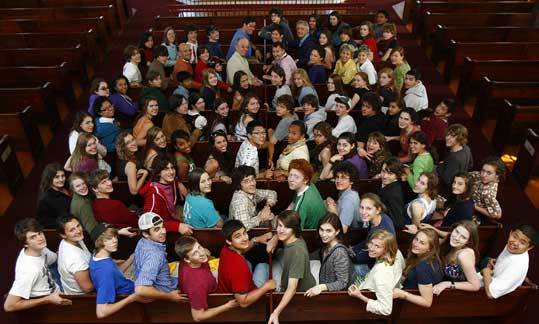
this is us:
 not to be confused with these babies:
 and about to look very much like this at 9:15 sunday morning:

in other words, welcome to the blog for the CA New Orleans trip. if you are so inclined, feel free to pass along the address to friends, family, or other people you are fond of who might be interested in following the chronicles of our exciting adventures in the south...
see you all bright and early sunday. rockin' the yellow.
<3 sandy
[p.s. a note to everyone coming: liz isn't on the trip this year so grady and i volunteered to take over her blogging duties-- so basically, if you're interested in making a post on this... have you stories, pictures, grand revelations about the universe, or a funny anecdote... do come find one of us any time throughout the week. cool? cool.]
 not to be confused with these babies:
 and about to look very much like this at 9:15 sunday morning:
in other words, welcome to the blog for the CA New Orleans trip. if you are so inclined, feel free to pass along the address to friends, family, or other people you are fond of who might be interested in following the chronicles of our exciting adventures in the south...
see you all bright and early sunday. rockin' the yellow.
<3 sandy
[p.s. a note to everyone coming: liz isn't on the trip this year so grady and i volunteered to take over her blogging duties-- so basically, if you're interested in making a post on this... have you stories, pictures, grand revelations about the universe, or a funny anecdote... do come find one of us any time throughout the week. cool? cool.]
Subscribe to:
Comments (Atom)